| Description:
This is one of the most revered temples to Shiva; it is one of the Panchabhoota
Stalams signifying the 5 elements of wind (Kalahasti),
water (Tiruvanaikka), fire (Tiruvannamalai), earth (Kanchipuram) and space (Chidambaram).
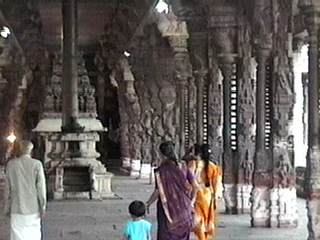
It is a vast temple with many an endowment from the Vijayanagar rulers, as seen in the
long corridors, towering gopurams and mandapams. This is the 1st of the
32 Tevara Stalams in the Tondai region of South India. There are several Shiva temples
scattered all over Kanchipuram, and it is to be noted that there is no separate shrine for
Parvati in any of them. The Kamakshiamman temple
is the only Ambal shrine in Kanchipuram. In Kanchi, the Ekambreswarar, Kamakottam
temples with Kumarakottam
in between denote Somaskandar.
History: This vast temple
with high rising Gopurams dominates the skyline of Kanchipuram the historic capital of the
Pallavas. Kanchipuram - a temple town is considered to be the foremost among the seven
prime pilgrimage centers in India. Along with Mamallapuram and Tirukkalunkunram, this town attracts the attention
of several tourists in Chennai. Also in Kanchipuram is the grand Varadarajar
temple along with several other temples revered by the tamil hymns of the Alwars
of the 1st millennium.
The
Pallavas, Cholas and the Vijayanagar
Kings especially Krishna Deva Raya have contributed to this temple.
Second century AD Tamil poetry speaks of Kamakottam,
and the Kumarakottam (currently the Kamakashi
Amman temple and the Subramanya temple). Tiruvacakam, Tirukkovaiyaar,
Kanchipuranam, Manimekalai etc. speak of the glory of Kanchi the city.The existing structure then, was pulled down and rebuilt by the Pallava
Kings. The Cholas who came in later also made several contributions to the temple.
Architecture: The temple
covers an area of over 40 acres. The Raja Gopuram or the entrance tower
to the temple which rises to a height of 172 feet was built by the Vijayanagar Monarch Krishnadevaraya.
The pillared hall in front of the sanctum was also built by the Vijayanagar Kings.
Deities: The presiding
deity here is Ekambareswarar or Shiva, worshipped as the Prithivi Lingam.
A Somaskanda panel featuring Shiva, Parvati and Skanda adorns the rear of
the main shrine, which has been held in worship for centuries together. It is believed
that Parvati, the consort of Shiva worshipped him in the form of a Prithivi Lingam, or a
Lingam improvised out of sand, under a mango tree. Legend has it that the neighboring Vegavati
river overflowed and threatened to engulf the Shiva Lingam and that Parvati or Kamakshi,
embraced the Lingam, and Shiva, touched by the gesture materialized in person and married
her. In this context he is referred to as 'Tazhuvakkuzhainthaar' in
Tamil.
As mentioned before, there is no separate
shrine for Ambal or the Goddess in the temple as she is worshipped along with Shiva, as in
every other Shiva temple in the precincts of the town of Kanchipuram.
There is another shrine of Shiva and
Kamakshi under the Stala Vruksham or the Temple tree, which is a mango tree said to be
3500 years old. The mango tree is said to be the embodiment of the four Vedas and the tree
is said to bear fruits of four different tastes each season here.
The Saint poet Sundaramoorthy Nayanar is
said to have recovered his eyesight (left eye) after offering worship here.
Festivals and Services: (See
also below): Six worship services are offered each day in this temple - namely UshadKalam,
Kaalasanthi, Uchi Kaalam, Pradosham and Sayarakshai and Ardhajamam. Colorful festivals
such as Ani Tirumanjanam (June-July), Adi Kritikai (July-Aug), Avani Moolam (Aug - Sep),
Navaratri (Sep-October), Kartikai Deepam (Nov-Dec), Thai Poosam (Jan-Feb), Panguni Uthiram
(Mar-Apr), Chitra Pournami (Apr-May) and Vaikashi Vishakam (May-June) mark the temple's
annual calendar. The Panguni festival lasts for 13 days and it is during this festival
that the wedding of the presiding deity is celebrated, and the venerated Tamil poems of
the Nayanmars (Tirumurais) are sung in great splendor.
Other: Nilaathungal Tunda Perumaal
- Vishnu is worshipped in a small shrine in one of the corridors.The works of the Alwars
refer to the Vishnu shrine here and it is revered as one of the 108
Divya Desams as well.
|